
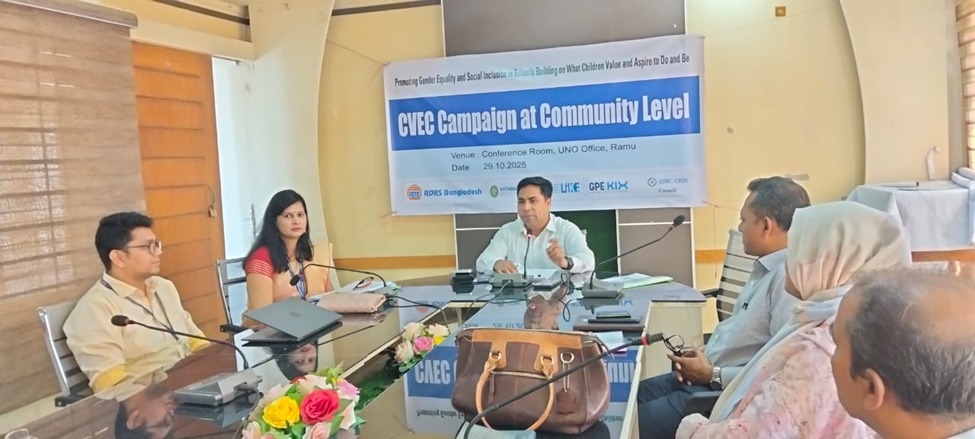
Event Report: CVEC Campaign at Community Levels
Project Name: Promoting Gender Equality and Social Inclusion in Schools: Building on What Children Value and Aspire to Do and Be
Event Summary
- Milestone: 15 – Conducting Capabilities Campaign at the School and Community Level
- Implementation Period: 27 October – 25 November 2025
- Locations & Dates:
- Teknaf Upazila – 27 October 2025
- Ramu Upazila – 29 October 2025
- Ukhiya Upazila – 11 November 2025
- Cox’s Bazar Sadar – 22 January 2026
- Maheshkhali Upazila – 25 November 2025
- Venues: Upazila Education Offices, UNO Offices, community conference rooms, and Ghativanga Government Primary School, DPEO Office
- Total Participants: 115 (Male: 79; Female: 36)
- Chief Guests:
- District Primary Education Officer (DPEO), Cox’s Bazar
- Upazila Nirbahi Officers (UNO) – Ramu & Ukhiya
- Upazila Education Officers (UEO) – Teknaf & Cox’s Bazar Sadar
- Participants: Education officials, head teachers, assistant teachers, parents, community leaders, and civil society representatives
- RDRS Bangladesh Representatives: Project Manager, Research Associate, and Education Facilitators
Overview
RDRS Bangladesh organized a series of CVEC (Children’s Valued Educational Capabilities) Campaigns at both school and community levels across Teknaf, Ramu, Ukhiya, Cox’s Bazar Sadar, and Maheshkhali under the project “Promoting Gender Equality and Social Inclusion in Schools: Building on What Children Value and Aspire to Do and Be.”
These campaigns aimed to institutionalize LIKE Clubs and promote capability-based, participatory, and inclusive education systems. The events convened key education stakeholders, including district and upazila-level officials, teachers, parents, and community members, to strengthen collaboration, ownership, and sustainability of project interventions.
Special emphasis was placed on operationalizing LIKE Clubs through participatory tools such as the Club Activity Book, the Capability Approach, and CVEC methodology, while fostering joyful learning, leadership, gender equality, mental well-being, and social inclusion.
Objectives
- To institutionalize CVEC and LIKE Clubs at school and community levels.
- To promote participatory, gender-responsive, and socially inclusive education practices.
- To enhance understanding of the Capability Approach and its application in school-based learning.
- To strengthen collaboration among education offices, schools, parents, and communities for sustainability.
- To build ownership and accountability among local stakeholders.
Discussion Highlights
Across all locations, the sessions followed a participatory structure including inaugural remarks, technical presentations, facilitated discussions, and stakeholder reflections.
Key Presentations
Project Overview and CVEC Framework (Md. Nazmul Hossain, Research Associate):
- Overview of project activities implemented across Cox’s Bazar district.
- Introduction to the Capability Approach and its relevance to inclusive education.
- Explanation of the 16 child-identified valued educational capabilities.
- Milestones achieved, implementation roadmap, and expected outcomes.
LIKE Club Methodology and Participatory Tools (Project Manager & Education Facilitators):
- Vision, Mission, and Objectives of LIKE Clubs
- Vision: Inclusive, safe, and empowered learning environments.
- Mission: Promote gender equality and social inclusion in schools.
- Objectives: Foster confidence, kindness, participation, leadership, and well-being among children.
- Club Structure and Operations
- Student-led leadership roles (President, Secretary, Coordinators).
- Inclusive membership across gender, ability, and grade.
- Regular meetings, documentation, and participatory decision-making.
- Activity Book and Planning Toolkit
- Alignment of activities with the 16 valued capabilities.
- Annual planning, monitoring, and reflection mechanisms.
- Strong focus on GESI, mental well-being, and joyful learning.
Guests’ Reflections (in Brief)
- District Education Officials highlighted the relevance of LIKE Clubs and CVEC campaigns in improving student attendance, confidence, leadership, and engagement. They emphasized joyful learning, empathy in teaching, and alignment with national education priorities. Several officials expressed interest in visiting project schools and replicating the initiative in other institutions.
- Upazila Nirbahi Officers (UNO) stressed the importance of addressing broader social challenges such as child marriage, drug abuse, environmental awareness, and safe learning environments through school–community collaboration.
- Teachers’ Reflections indicated noticeable improvements in student confidence, participation, leadership, peer learning, and communication skills. Teachers appreciated training on bullying prevention, positive thinking, life skills, and nurturing students’ aspirations, noting positive impacts on classroom dynamics and school culture.
- Parents and Community Members expressed support for LIKE Clubs and committed to active involvement in sustaining inclusive and participatory learning environments.
School-Level Highlight: At Ghativanga Government Primary School, Maheshkhali, the CVEC campaign also marked the formal inauguration of the LIKE Club through a ribbon-cutting ceremony by the District Primary Education Officer. The event reinforced the role of schools as hubs for capability-based learning and community engagement, with strong commitments from teachers, parents, and education officials.
Outcomes
- Strengthened coordination among RDRS Bangladesh, District Education Office, Upazila Education Offices, schools, and communities.
- Enhanced understanding of capability-based and participatory education approaches.
- Renewed institutional commitment to sustain LIKE Clubs and CVEC initiatives.
- Increased ownership and accountability among teachers, parents, and local stakeholders.
- Positive momentum toward scaling inclusive, child-centered learning practices across Cox’s Bazar district.
Conclusion
The combined CVEC campaigns across Teknaf, Ramu, Ukhiya, Cox’s Bazar Sadar, and Maheshkhali successfully advanced the institutionalization of LIKE Clubs by raising awareness, strengthening partnerships, and promoting gender equality and social inclusion in education. Through collaborative engagement among education officials, teachers, parents, and communities, the initiative continues to lay a strong foundation for sustainable, capability-based learning models that empower children to grow as confident, empathetic, and inclusive citizens.